Workflow Transformation & SaaS Implementation
I conducted a full operational and financial analysis of care delivery that led to a redesigned assisted living pricing model based on the true cost of service.
To make those decisions measurable and defensible in real time, I then designed the concept and workflow for a software-enabled service verification system that eliminated the need for future deep-dive studies and allowed care level adjustments to be justified instantly.
The Challenge
Care staff consistently reported providing more support than residents were being billed for, but there was no objective way to verify services in real time. Residents often underestimated how much assistance they required, and families were not always convinced that additional care was needed or being delivered.
This created two critical risks:
• Delayed or resisted care level increases
• Revenue loss on the highest-acuity residents
To understand the scope of the problem, I conducted a full operational analysis of every resident, measuring the actual time required to deliver each service and calculating the true cost of care.
The findings showed that the organization was losing money on residents who required the most support because pricing was not aligned with real care delivery.
The challenge was to translate this one-time deep operational analysis into a live workflow that could produce verifiable service data in real time, eliminating the need for future manual studies and enabling accurate care level determination, defensible pricing, and ongoing regulatory compliance.
Impact at a Glance
Data-Driven Pricing Model
Aligned service levels with the true cost of care, increasing assisted living revenue and pricing accuracy.
Real-Time Service Verification
Replaced subjective care debates with time-based, defensible service records.
Live Operational Visibility
Shifted care tracking from end-of-shift documentation to real-time operational intelligence.
Regulatory & Financial Risk Reduction
Strengthened regulatory compliance while eliminating revenue loss on high-acuity residents.
Scalable Workflow Infrastructure
Designed a QR-based, SaaS-enabled workflow and embedded it into daily staff routines.
My Role
In addition to leading the workflow implementation, I conducted a full cost-of-care analysis by measuring the time required for each service across all residents and translated that operational data into a new assisted living pricing structure aligned with actual care delivery.
The digital workflow became the infrastructure that sustained this model, continuously capturing real-time verification of services provided.
Strategic Approach
I began by reverse-engineering daily care delivery into its core components: who performs each service, when it must be completed, how it is documented, and how completion is verified. This made both service delivery and staff performance objectively visible and created a foundation for data-driven staffing, care level determination, and financial accuracy. From this, I designed a workflow architecture that could be digitized into real-time task tracking.
The system was built around three priorities:
• Frontline simplicity and speed of use
• Real-time operational visibility for leadership across both staffing and resident service utilization
• Verifiable documentation for regulatory compliance and defensible pricing
Rather than forcing staff to adapt to new technology, the workflow was structured around existing movement patterns and responsibilities, allowing adoption to occur naturally within daily routines while continuously generating live service data.
Systems Designed
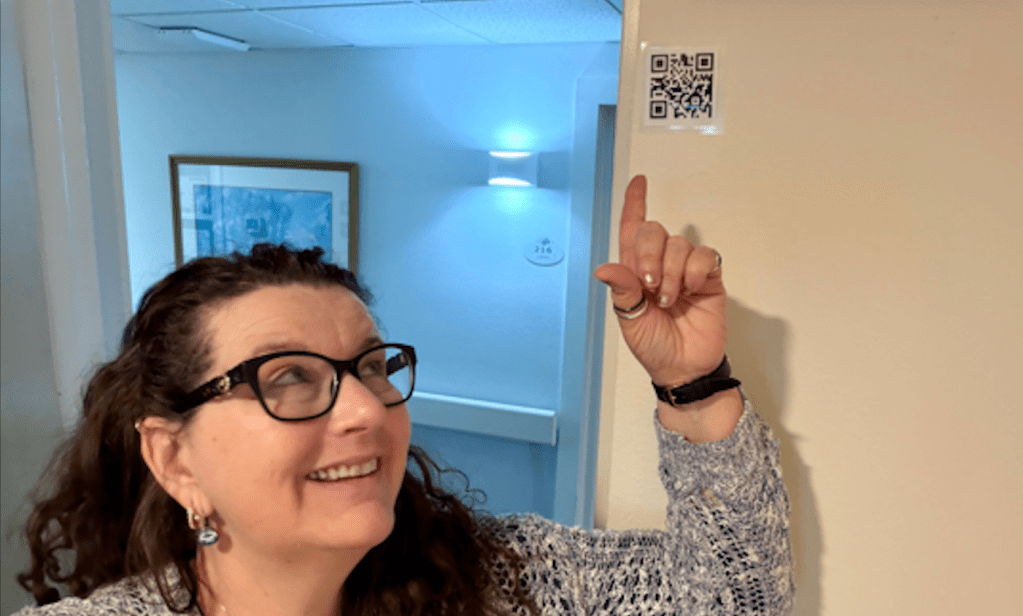
Each resident apartment was assigned a unique QR code that staff could scan using a mobile device. Scanning the code opened a role-specific task list with defined services, documentation prompts, and completion tracking.
The system created:
• Time-stamped verification of completed tasks
• Real-time visibility into both service delivery and staff performance
• A digital performance record tied to actual workflow execution and resident utilization
This transformed care delivery from a retrospective documentation process into a live operational system that informed staffing decisions, care level accuracy, and financial alignment in real time.
Platform Integration & Product Expansion
Implemented in partnership with a multi-community SaaS platform
I partnered with CareSynchrony, a SaaS-based care coordination platform, to translate the workflow model into a scalable software capability.
The QR-based service verification framework was incorporated into their core product and positioned for multi-site deployment, transforming the initiative from a single-community operational improvement into a product-level solution.
This work also led to contract negotiations for a complementary application focused on real-time care coordination and integrated operational decision support.
Operational Infrastructure
Operational Deployment
- Deployment required physical environment mapping, workflow alignment, and behavioral adoption across departments.
- QR codes were placed at care points based on staff movement patterns. Task architecture aligned to shift responsibilities, with completion protocols standardized system-wide.
- This created a repeatable operational model that allowed the digital workflow to function in a live care environment.
Product Enablement
- Workflow designed for software translation
- Structured, repeatable task architecture
- Real-time data capture model
- Scalable across multiple communities
- Designed for integration within SaaS deployment environments
Outcomes
This system created a direct connection between care delivery, compliance, and revenue by turning real-time staff activity into defensible financial and clinical decisions.
The workflow system converted care delivery from a subjective discussion into a transparent, data-supported model.
By connecting real-time service verification to the cost-of-care analysis, the organization was able to:
• Increase assisted living revenue by aligning pricing with actual services delivered
• Reduce disputes with residents and families through clear, time-based service records
• Eliminate financial loss on high-acuity residents
• Strengthen regulatory readiness with verifiable documentation
What had previously been a retrospective and often contested process became a real-time operational and financial decision-making system.
Leadership Reflection
This project demonstrated that meaningful digital transformation begins with operational truth.
The technology did not create the insight, the insight came from measuring how care was actually delivered, translating that into a cost model, and then building a system that could capture the data in real time.
By connecting human workflow, financial structure, and compliance requirements into a single live system, I moved from managing services to designing infrastructure that supports clinical, regulatory, and business decision-making simultaneously.
 Shirin McComb